
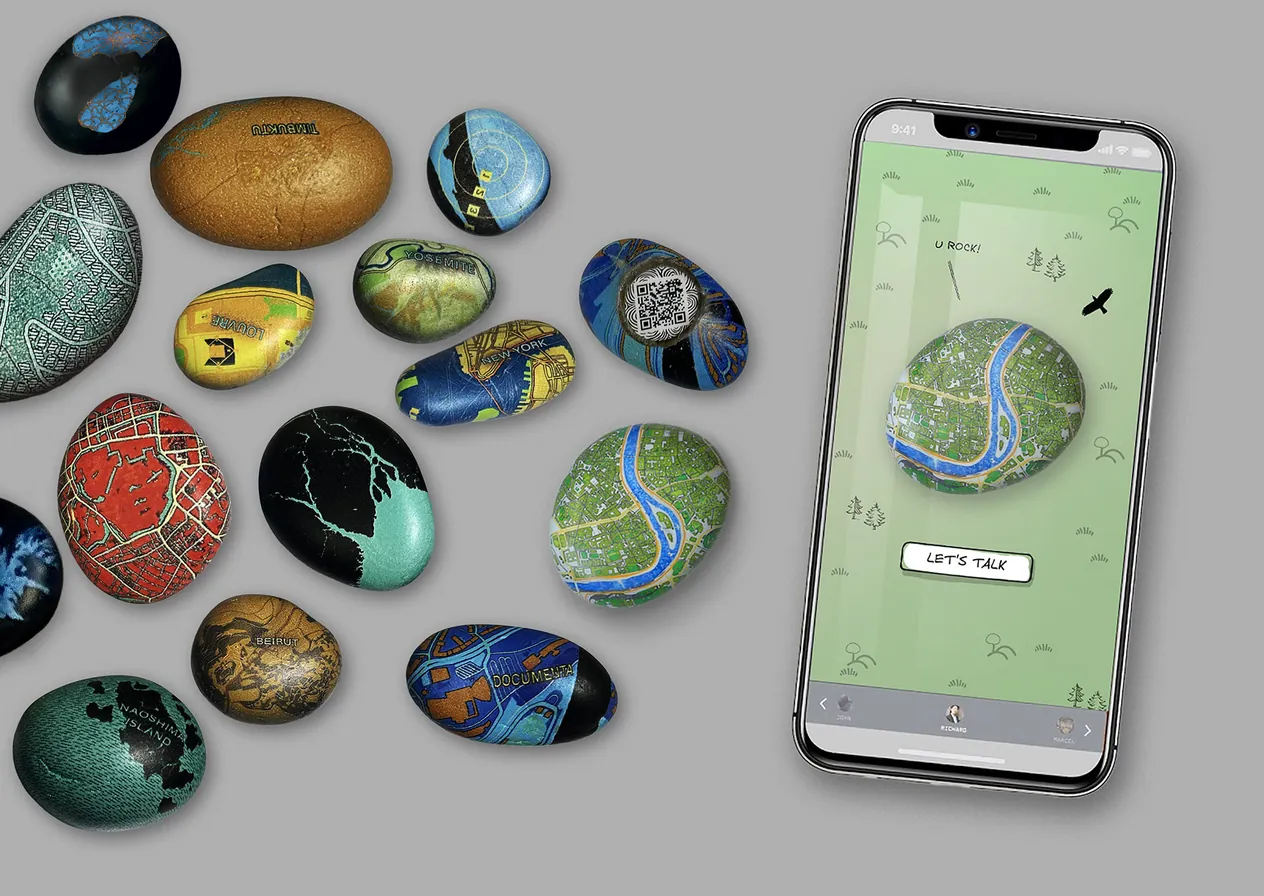
A small stone sits in the hand. Its smooth surface carries a map — a city, a coastline, a river delta, a home. A Stonemap. A fragment of the Earth, embellished with an abstract representation of itself. Both ancient and new, a Stonemap is a personal talisman and a cartographic touchstone.
It’s physical, it’s virtual, it fits in your pocket, and it talks.
Scan the stone and a Progressive Web App opens. It carries the voice of the Planetary Emissary, a conversational AI grounded in place, geological time, and curiosity. It listens more than it speaks.
Beside the conversation, the app holds two map-based spaces: the Commons, where holders exchange what they find, and Voyages, where stones share encounters from their travels as they pursue their intentions in the world.
Each stone’s map is imprinted with lightfast pigment inks using a hydrographic transfer process. Through surface tension the ink transfers all around the stone, like a permanent tattoo of place. No two stones are identical.
Stonemaps began in 2013 with a winter’s walk on a fog-enshrouded beach on the Sunshine Coast. With no horizon and no landscape, a sense of place remained, carried like a worn map. Maps wrapped around stones became the first Stonemaps.
Prototyping developed in R&D labs in California, then Vancouver. The concept was formalized in a peer-reviewed paper, Stonemaps: A Slow Intentional Network for Collective Sentience, presented at ISEA 2020. Prototypes have since been iterated into production-grade stones, and 75 have been made. The recent arrival of conversational AI gave the stones a voice.
75 prototype stones are ready for field testing. They will travel as gifts through willing hands, testing holder experience, movement, and exchange. Each stone’s Planetary Emissary will log anonymized insights to a Journal of Findings, a research corpus that informs its own evolution. The field test will:
- Test the Emissary in real conversation, outside controlled settings
- Learn how holders interact with Stonemaps and the app
- Track how stones move — who holds them, how long, how far
This is a short introduction while the full site is prepared. Questions about the project: vanillafivecreative@gmail.com